


Making decisions without diagnosis is guessing. And guessing in business has a very precise cost: it is called lost opportunity. Strategic diagnosis is the exercise that separates companies that grow with intent from those that grow by inertia or not at all.
What exactly is a strategic diagnosis?
A strategic diagnosis is a structured analysis of a company’s current situation: its position in the market, its value proposition, its real strengths, its blind spots and the opportunities it is not taking advantage of. It is neither a performance evaluation nor a financial analysis. It is an x-ray of the company as a competitive player in its industry.
Unlike a business plan (which looks to the future) or a performance report (which looks to the past), the strategic diagnosis looks honestly at the present. And that honesty is what makes it possible to make better decisions about the future.
A doctor who prescribes drugs without making a diagnosis is not negligent: he is dangerous. The same applies to any consultant, agency or management team that designs strategies without first understanding where the company really is.
What the diagnosis reveals
In our experience working with companies in Colombia and Spain, the strategic diagnosis consistently reveals six dimensions that few organizations have clearly mapped:
ACTUAL MARKET POSITION
How your current customers perceive you vs. how you think they perceive you. The gap between these two realities is often revealing.
REAL VALUE PROPOSAL
What is the value that your customers actually buy that is often not what the company thinks it is selling.
COMPETITIVE ADVANTAGES
What it does better than any alternative, what it says it does better but cannot demonstrate, and what it does not do at all.
FRICTION POINTS
Where you are losing customers, money and time without knowing it. Every identified friction is a measurable improvement opportunity.
GROWTH OPPORTUNITIES
Which markets, segments or services have the greatest potential with the lowest incremental investment. The most efficient growth.
NON-VISIBLE RISKS
Vulnerabilities that do not appear in financial reports but may compromise future growth if not addressed.
How to make a good diagnosis
Not all diagnostics are the same. A superficial diagnosis produces generic recommendations that could apply to any company in your industry. A well-done diagnostic produces findings so specific that they only make sense for your company, at your current time. This is the process we follow at Perspectiva-K:
01 – LEADERSHIP INTERVIEWS
In-depth conversations with the management team to understand the vision, real objectives, unspoken fears and decisions that have been made (and avoided) over the past year.
→ DELIVERABLE: Map of targets and internal stress points.
02 – EXTERNAL POSITIONING ANALYSIS
Review of how the company appears in all its digital channels, how it communicates versus the competition and what signals the market receives about its value proposition.
→ DELIVERABLE: Comparative positioning matrix.
03 – VOICE OF THE CUSTOMER
Analysis of testimonials, reviews, commercial feedback and cancellation patterns to understand what your customers really value and where the service frictions are.
→ DELIVERABLE: Customer perception insights.
04 – ANALYSIS OF CAPABILITIES AND RESOURCES
Honest assessment of what the company can do with excellence, what it can improve and what is beyond its reach. This clarity is the basis of any realistic strategy.
→ DELIVERABLE: Map of capabilities and gaps.
05 – SUMMARY AND PRIORITIES
Integration of all findings into an actionable document that ranks opportunities by impact and feasibility, and maps the smartest path to business objectives.
→ DELIVERABLE: Strategic roadmap with priorities.
When is the right time to do it?
There are times when strategic diagnosis is not optional: it is the difference between making a well-informed decision or betting blindly. These are the most frequent:
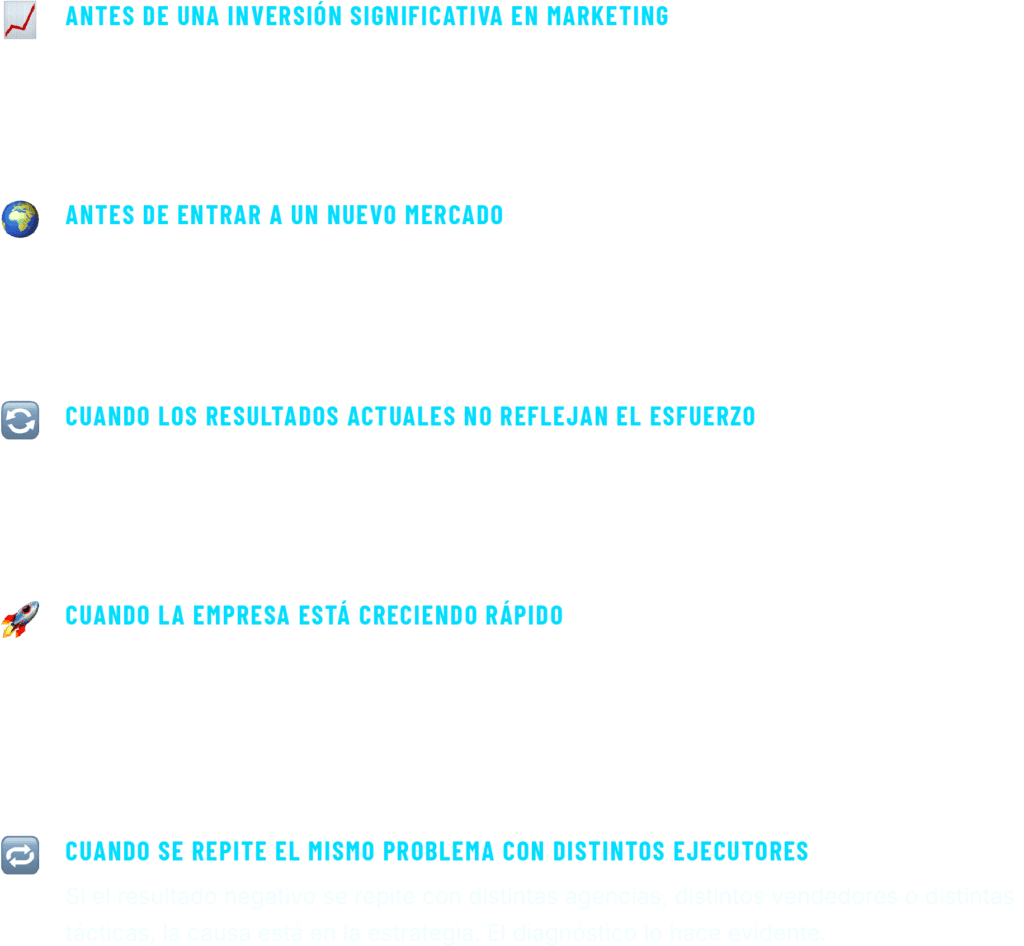
The recommended frequency for a formal strategic diagnostic is every 18 to 24 months, or whenever the market or business undergoes a significant change. Companies that do it regularly make better decisions, faster and with greater confidence.
Diagnosis as the first step of all
At Perspectiva-K, no project starts without a diagnosis. Not because it is a bureaucratic requirement, but because without understanding where your company is today, any proposal of where it should go tomorrow is an opinion, not a strategy.
Diagnosis does not guarantee success. It does guarantee that the decisions you make are based on reality, not assumptions. And in a competitive market, that difference is worth a lot.
Start with clarity, not assumptions.
We offer you an initial 30-minute diagnostic session at no cost. A
structured conversation to identify where your company is and what is the
smartest move you can make now.